

Prerequisites
- You must be signed in as a user who has the Object Storage Admin IAM role (or equivalent legacy access, such as membership in the
admingroup). - You must have an AI Object Storage access key to revoke.
Revoke keys in Cloud Console
Use the Cloud Console to revoke a single access key through the web UI. This is the quickest option when you know which key to revoke and only need to revoke one at a time.- Navigate to the Access Keys page in the Cloud Console.
-
Use the Search function to find keys by name or principal.
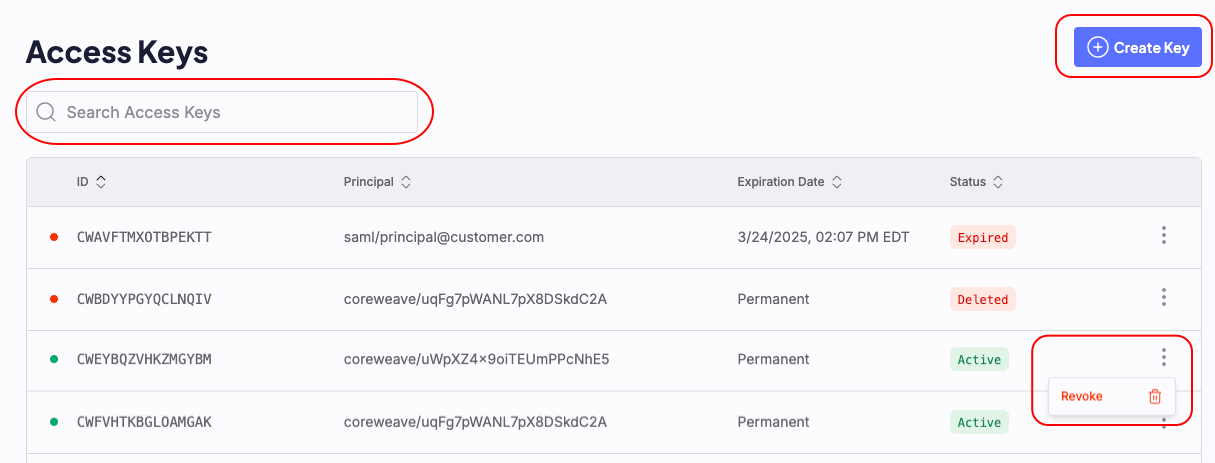
- Click the More menu on the right of the key you want to revoke.
- Click Revoke.
- In the Revoke Key modal, type the ID of the key you want to revoke and click Revoke. Typing the ID confirms that you intend to revoke this specific key.
Revoke keys with the Object Storage API
Use the Object Storage API to script revocations, integrate revocation into automated workflows, or revoke many keys at once. The Object Storage API provides endpoints to revoke individual access keys, or all keys associated with a principal.Revoke an individual access key
Use this approach when you need to invalidate one specific key, such as when a single credential is compromised or no longer needed. To revoke an access key, first create a JSON object that specifies the key ID. Replace[ACCESS-KEY-ID] with the ID of the key to revoke.
data.json
/revoke-access-key/access-key endpoint with the JSON object in the body. Replace [API-ACCESS-TOKEN] with your API access token.
Example request
Response status code 200
Revoke all access keys for a principal
Use this approach to revoke every key associated with a single principal at once, such as when a user leaves your organization or when you need to fully rotate credentials for a service account. To revoke all access keys for a principal, create a JSON object that specifies the principal name. Replace[PRINCIPAL-NAME] with the principal whose keys you want to revoke (for example, coreweave/user-uid or saml/user@example.com).
data.json
/revoke-access-key/principal endpoint with the JSON object in the body. Replace [API-ACCESS-TOKEN] with your API access token.
Example request
Response status code 200