> ## Documentation Index
> Fetch the complete documentation index at: https://docs.coreweave.com/llms.txt
> Use this file to discover all available pages before exploring further.
# Anthropic
> Weave를 사용하여 Anthropic SDK로 수행한 LLM Call을 자동으로 추적하고 로깅하세요
 코드에 Weave를 통합하면 Weave가 [Python](https://github.com/anthropics/anthropic-sdk-python)과 [TypeScript](https://github.com/anthropics/anthropic-sdk-typescript)용 Anthropic SDK로 수행한 LLM Call을 모두 자동으로 추적하고 로깅합니다. 이를 위해 Weave는 Anthropic의 `Messages.create()` 메서드를 자동으로 호출합니다.
이 가이드에서는 Anthropic SDK로 작업할 때 트레이스를 캡처하고, 직접 작성한 함수를 Op으로 래핑하고, 실험에 재사용할 수 있는 `Model`을 구축하고, 도구 사용을 추적하는 방법을 설명합니다. 이러한 패턴을 활용하면 맞춤형 로깅 코드를 따로 작성하지 않고도 Claude 기반 애플리케이션을 디버그하고, 비교하고, 반복적으로 개선할 수 있습니다.
코드에 Weave를 통합하면 Weave가 [Python](https://github.com/anthropics/anthropic-sdk-python)과 [TypeScript](https://github.com/anthropics/anthropic-sdk-typescript)용 Anthropic SDK로 수행한 LLM Call을 모두 자동으로 추적하고 로깅합니다. 이를 위해 Weave는 Anthropic의 `Messages.create()` 메서드를 자동으로 호출합니다.
이 가이드에서는 Anthropic SDK로 작업할 때 트레이스를 캡처하고, 직접 작성한 함수를 Op으로 래핑하고, 실험에 재사용할 수 있는 `Model`을 구축하고, 도구 사용을 추적하는 방법을 설명합니다. 이러한 패턴을 활용하면 맞춤형 로깅 코드를 따로 작성하지 않고도 Claude 기반 애플리케이션을 디버그하고, 비교하고, 반복적으로 개선할 수 있습니다.
트레이스
코드에 `weave.init("your-team-name/your-project-name")`를 추가하면 Weave가 Anthropic SDK의 트레이스를 자동으로 캡처합니다. `weave.init()`에 팀 이름을 인수로 지정하지 않으면 Weave는 [기본 W\&B entity](/ko/products/wandb/platform/app/settings-page/user-settings#default-team)에 출력을 로깅합니다. 프로젝트 이름을 지정하지 않으면 Weave 초기화가 실패합니다.
다음 예시는 기본적인 Anthropic Call에 Weave를 통합하는 방법을 보여줍니다.
```python lines {6} theme={"system"}
import weave
# anthropic 라이브러리를 평소처럼 사용합니다
import os
from anthropic import Anthropic
weave.init("anthropic_project")
client = Anthropic(
api_key=os.environ.get("ANTHROPIC_API_KEY"),
)
message = client.messages.create(
max_tokens=1024,
messages=[
{
"role": "user",
"content": "Tell me a joke about a dog",
}
],
model="claude-3-opus-20240229",
)
print(message.content)
```
```typescript twoslash theme={"system"}
// @noErrors
import Anthropic from '@anthropic-ai/sdk';
import * as weave from 'weave';
import { wrapAnthropic } from 'weave';
await weave.init('anthropic_project');
// 트레이싱을 활성화하려면 Anthropic 클라이언트를 래핑합니다
const client = wrapAnthropic(new Anthropic());
const message = await client.messages.create({
max_tokens: 1024,
messages: [
{
role: 'user',
content: 'Tell me a joke about a dog',
}
],
model: 'claude-3-opus-20240229',
});
console.log(message.content);
```
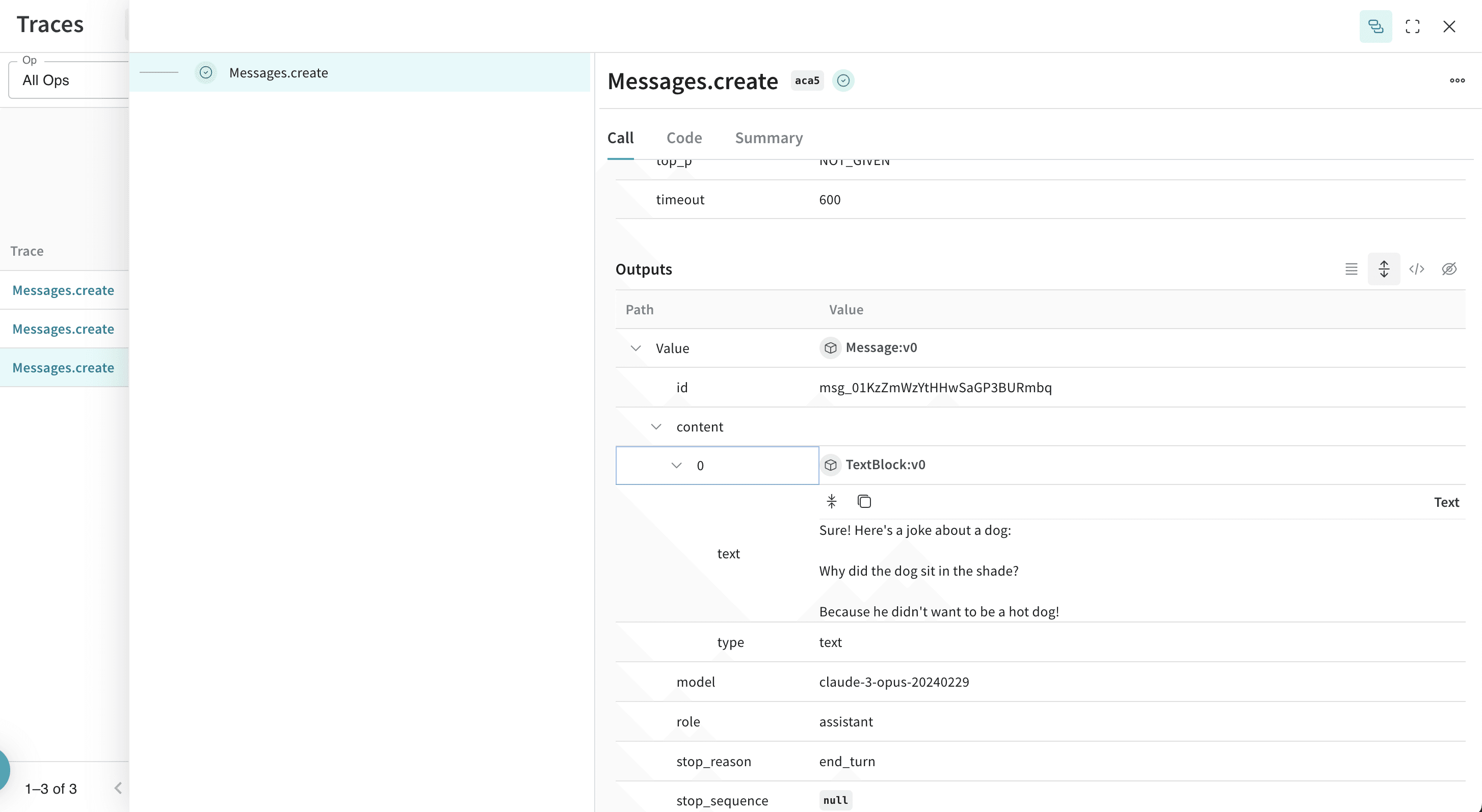
코드에 `weave.init()`를 포함하면 Weave가 트레이싱 정보를 자동으로 캡처하고 링크를 출력합니다. 이 링크를 클릭하면 Weights & Biases UI에서 트레이스를 확인할 수 있습니다.
[ ](https://forge.coreweave.com/wandb/capecape/anthropic_project/weave/calls)
직접 만든 Op로 래핑하기
`weave.init()`만으로도 Anthropic SDK Call이 캡처되지만, 직접 작성한 함수를 Op로 데코레이트하면 각 모델 Call을 둘러싼 애플리케이션 로직까지 담긴 더 풍부한 트레이스를 얻을 수 있습니다.
Weave Op는 실험을 진행하는 동안 코드 버전을 자동으로 관리하고 입력과 출력을 캡처합니다. [`Anthropic.messages.create()`](https://platform.claude.com/docs/en/build-with-claude/working-with-messages)를 호출하는 함수를 Python에서는 [`@weave.op()`](/ko/products/wandb/weave/guides/tracking/ops)로 데코레이트하고, TypeScript에서는 [`weave.op()`](/ko/products/wandb/weave/reference/typescript-sdk/functions/op)로 래핑하세요. 그러면 Weave가 입력과 출력을 자동으로 추적합니다.
다음 예시는 함수를 추적하는 방법을 보여줍니다.
```python lines {5,10,24} theme={"system"}
import weave
import os
from anthropic import Anthropic
weave.init("anthropic_project")
client = Anthropic(
api_key=os.environ.get("ANTHROPIC_API_KEY"),
)
@weave.op()
def call_anthropic(user_input:str, model:str) -> str:
message = client.messages.create(
max_tokens=1024,
messages=[
{
"role": "user",
"content": user_input,
}
],
model=model,
)
return message.content[0].text
@weave.op()
def generate_joke(topic: str) -> str:
return call_anthropic(f"Tell me a joke about {topic}", model="claude-3-haiku-20240307")
print(generate_joke("chickens"))
print(generate_joke("cars"))
```
```typescript twoslash theme={"system"}
// @noErrors
import Anthropic from '@anthropic-ai/sdk';
import * as weave from 'weave';
import { wrapAnthropic } from 'weave';
await weave.init('anthropic_project');
const client = wrapAnthropic(new Anthropic());
const callAnthropic = weave.op(async function callAnthropic(
userInput: string,
model: string
): Promise {
const message = await client.messages.create({
max_tokens: 1024,
messages: [
{
role: 'user',
content: userInput,
}
],
model: model,
});
const content = message.content[0];
return content.type === 'text' ? content.text : '';
});
const generateJoke = weave.op(async function generateJoke(
topic: string
): Promise {
return callAnthropic(`Tell me a joke about ${topic}`, 'claude-3-haiku-20240307');
});
console.log(await generateJoke('chickens'));
console.log(await generateJoke('cars'));
```
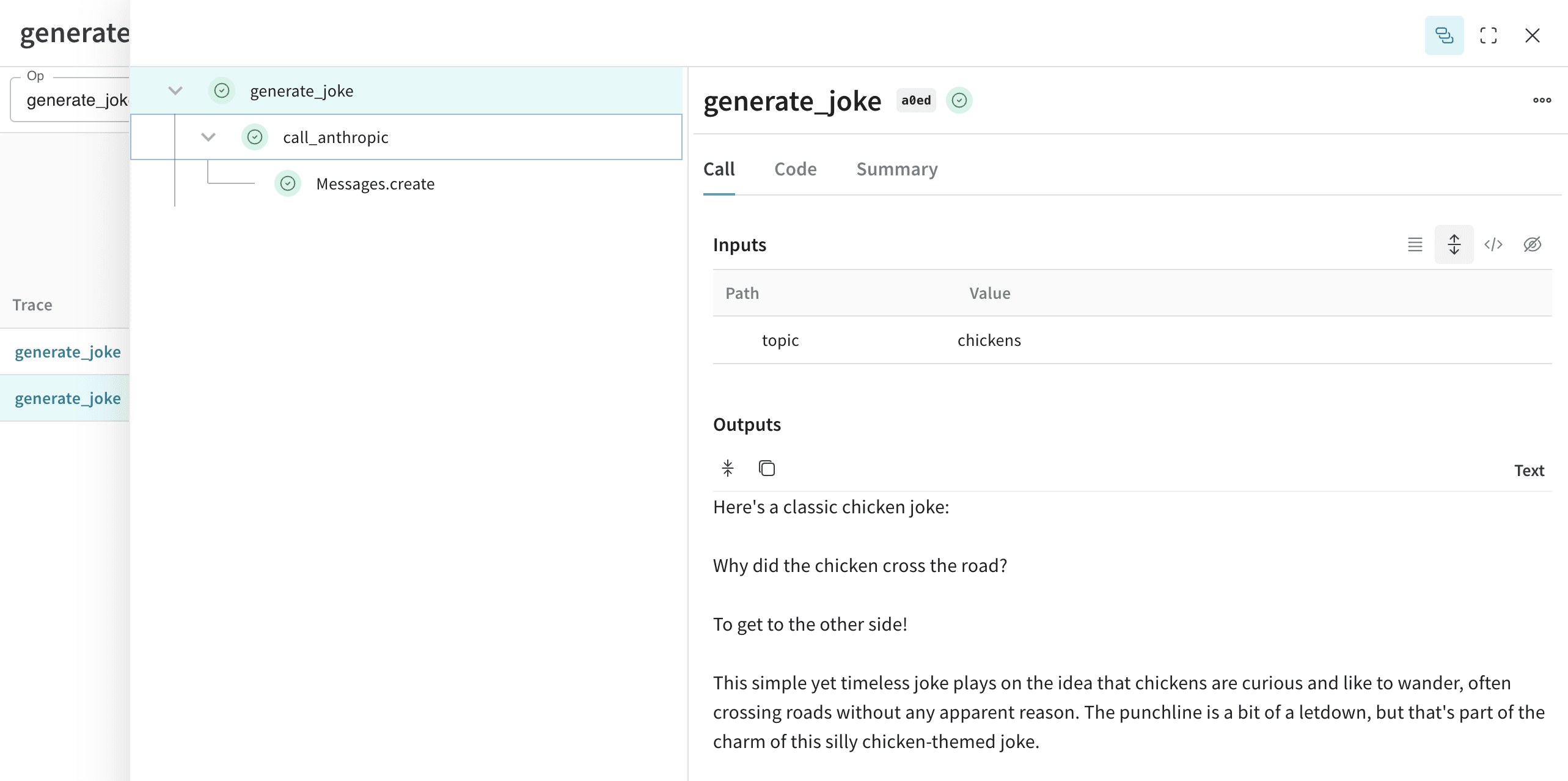
함수를 `weave.op()`로 데코레이트하면 Weave가 해당 함수의 코드, 입력, 출력을 캡처합니다. Op를 사용하면 중첩 함수를 포함해 원하는 어떤 함수든 추적할 수 있습니다.
[ ](/ko/products/wandb/weave/guides/tracking/ops)
더 쉽게 실험할 수 있도록 `Model` 만들기
개별 Call을 트레이싱하고 있다면, 다음 단계는 관련 매개변수를 한데 묶어 여러 설정을 비교할 수 있도록 하는 것입니다.
`weave.Model` 클래스는 Weave Python SDK에서만 사용할 수 있습니다. TypeScript에서는 `weave.op()` 래퍼를 사용하여 구조화된 매개변수가 있는 함수를 추적하세요.
바뀌는 요소가 많으면 실험을 체계적으로 관리하기 어렵습니다. [`Model`](/ko/products/wandb/weave/guides/core-types/models) 클래스를 사용하면 system 프롬프트나 사용 중인 모델 등 앱의 실험 세부 정보를 캡처하고 정리할 수 있으므로, 앱의 여러 반복 버전을 체계적으로 관리하고 비교할 수 있습니다.
모델은 코드 버전 관리와 입력 및 출력 캡처 외에도 애플리케이션의 동작을 제어하는 구조화된 매개변수를 캡처합니다. 이를 통해 어떤 매개변수가 가장 효과적인지 알아낼 수 있습니다. Weave 모델은 `serve` 및 [평가](/ko/products/wandb/weave/guides/core-types/evaluations)와 함께 사용할 수도 있습니다.
다음 예시에서는 `model`과 `temperature`를 바꿔 가며 실험할 수 있습니다.
```python lines theme={"system"}
import weave
# anthropic 라이브러리는 평소처럼 사용하세요
import os
from anthropic import Anthropic
weave.init('joker-anthropic')
class JokerModel(weave.Model): # `weave.Model`로 변경하세요
model: str
temperature: float
@weave.op()
def predict(self, topic): # `predict`로 변경하세요
client = Anthropic()
message = client.messages.create(
max_tokens=1024,
messages=[
{
"role": "user",
"content": f"Tell me a joke about {topic}",
}
],
model=self.model,
temperature=self.temperature
)
return message.content[0].text
joker = JokerModel(
model="claude-3-haiku-20240307",
temperature = 0.1)
result = joker.predict("Chickens and Robots")
print(result)
```
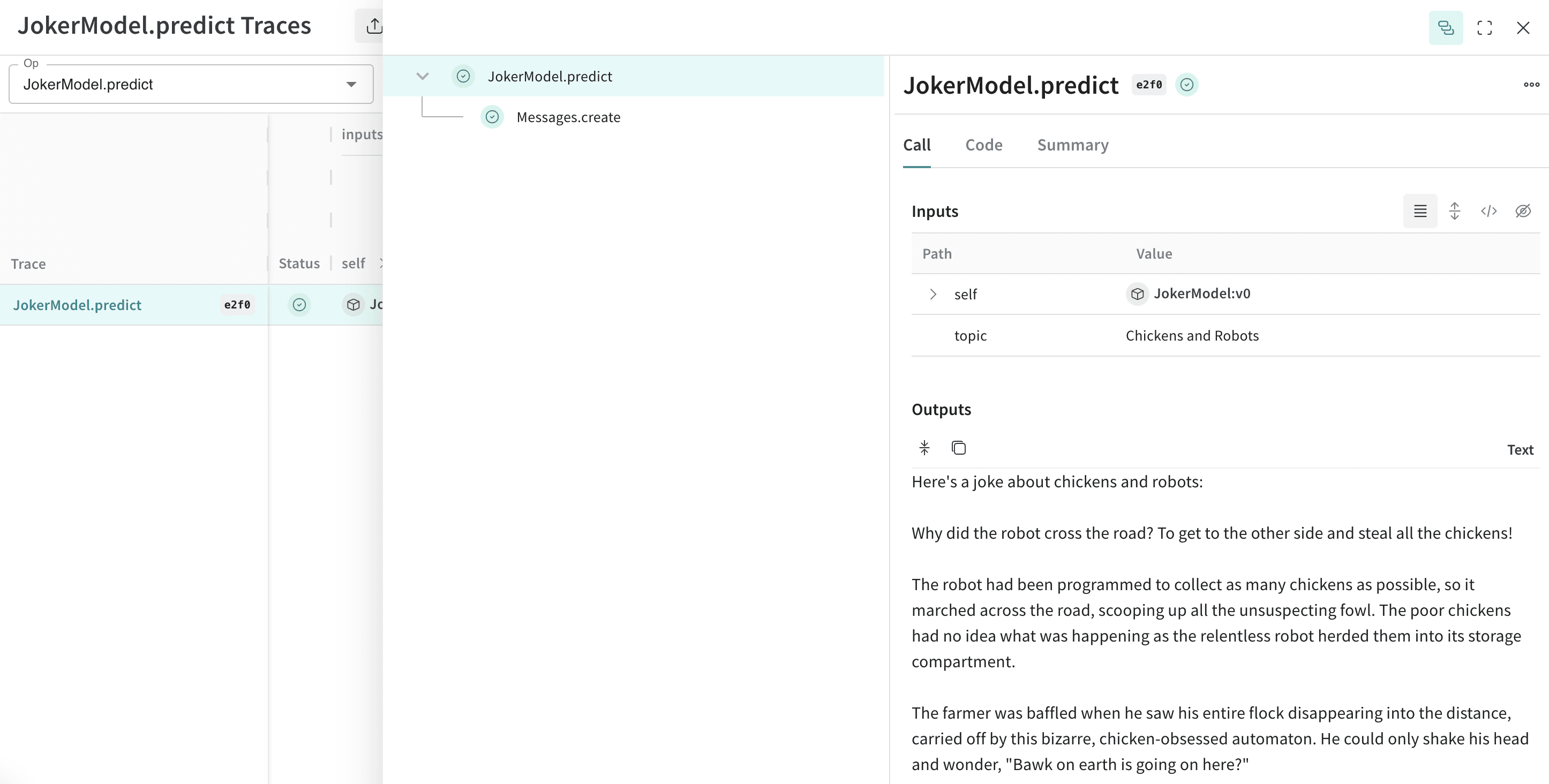
이 값 중 하나를 변경할 때마다 Weave는 `JokerModel`의 새 버전을 생성하고 추적합니다. 이를 통해 트레이스 데이터를 코드 변경 사항과 연결할 수 있으며, 사용 사례에 가장 적합한 설정이 무엇인지 확인하는 데에도 도움이 됩니다.
[ ](https://forge.coreweave.com/wandb/capecape/anthropic_project/weave/calls)
Weave는 일반 메시지뿐 아니라 Anthropic의 도구 사용 인터페이스도 계측하므로, 에이전트형 워크플로를 엔드투엔드로 트레이스할 수 있습니다.
Anthropic은 Claude가 함수 호출을 요청할 수 있도록 [도구](https://platform.claude.com/docs/en/agents-and-tools/tool-use/overview) 인터페이스를 제공합니다. Weave는 대화 전반에서 도구 정의, 도구 사용 요청, 도구 결과를 자동으로 추적합니다.
다음은 Anthropic 도구 설정을 보여 주는 축약된 예시입니다.
```python lines theme={"system"}
message = client.messages.create(
max_tokens=1024,
messages=[
{
"role": "user",
"content": "What's the weather like in San Francisco?",
}
],
tools=[
{
"name": "get_weather",
"description": "Get the current weather in a given location",
"input_schema": {
"type": "object",
"properties": {
"location": {
"type": "string",
"description": "The city and state, e.g. San Francisco, CA",
}
},
"required": ["location"],
},
},
],
model=model,
)
print(message)
```
```typescript twoslash theme={"system"}
// @noErrors
const message = await client.messages.create({
max_tokens: 1024,
messages: [
{
role: 'user',
content: "What's the weather like in San Francisco?",
}
],
tools: [
{
name: 'get_weather',
description: 'Get the current weather in a given location',
input_schema: {
type: 'object',
properties: {
location: {
type: 'string',
description: 'The city and state, e.g. San Francisco, CA',
}
},
required: ['location'],
},
},
],
model: 'claude-3-opus-20240229',
});
console.log(message);
```
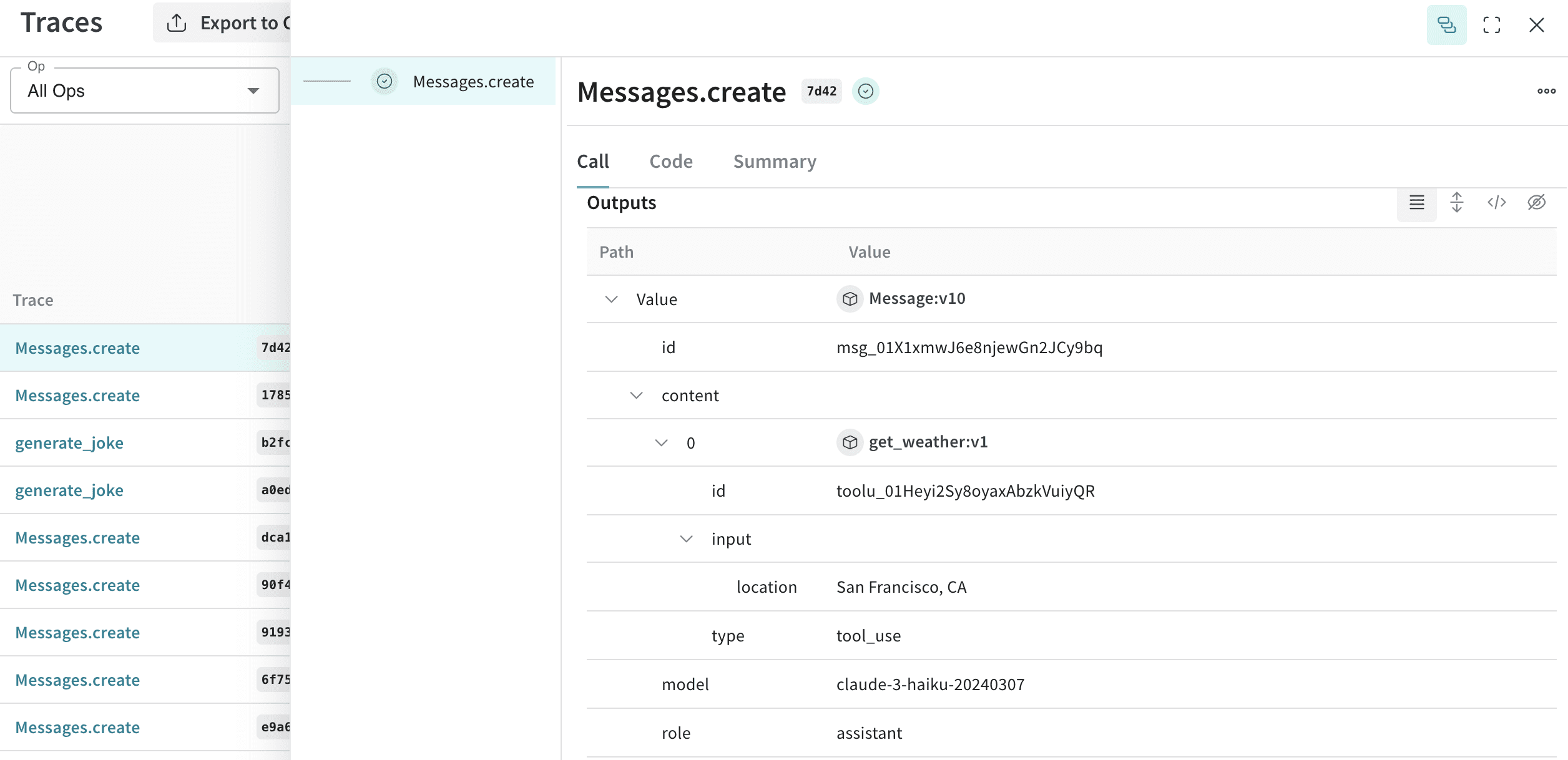
Weave는 대화의 각 단계에서 도구 정의, Claude의 도구 사용 요청, 도구 결과를 자동으로 캡처합니다.
[
](https://forge.coreweave.com/wandb/capecape/anthropic_project/weave/calls)
Weave는 일반 메시지뿐 아니라 Anthropic의 도구 사용 인터페이스도 계측하므로, 에이전트형 워크플로를 엔드투엔드로 트레이스할 수 있습니다.
Anthropic은 Claude가 함수 호출을 요청할 수 있도록 [도구](https://platform.claude.com/docs/en/agents-and-tools/tool-use/overview) 인터페이스를 제공합니다. Weave는 대화 전반에서 도구 정의, 도구 사용 요청, 도구 결과를 자동으로 추적합니다.
다음은 Anthropic 도구 설정을 보여 주는 축약된 예시입니다.
```python lines theme={"system"}
message = client.messages.create(
max_tokens=1024,
messages=[
{
"role": "user",
"content": "What's the weather like in San Francisco?",
}
],
tools=[
{
"name": "get_weather",
"description": "Get the current weather in a given location",
"input_schema": {
"type": "object",
"properties": {
"location": {
"type": "string",
"description": "The city and state, e.g. San Francisco, CA",
}
},
"required": ["location"],
},
},
],
model=model,
)
print(message)
```
```typescript twoslash theme={"system"}
// @noErrors
const message = await client.messages.create({
max_tokens: 1024,
messages: [
{
role: 'user',
content: "What's the weather like in San Francisco?",
}
],
tools: [
{
name: 'get_weather',
description: 'Get the current weather in a given location',
input_schema: {
type: 'object',
properties: {
location: {
type: 'string',
description: 'The city and state, e.g. San Francisco, CA',
}
},
required: ['location'],
},
},
],
model: 'claude-3-opus-20240229',
});
console.log(message);
```
Weave는 대화의 각 단계에서 도구 정의, Claude의 도구 사용 요청, 도구 결과를 자동으로 캡처합니다.
[ ](https://forge.coreweave.com/wandb/capecape/anthropic_project/weave/calls)