> ## Documentation Index
> Fetch the complete documentation index at: https://docs.coreweave.com/llms.txt
> Use this file to discover all available pages before exploring further.
# MistralAI
> Weave の自動トレース機能を使用して、MistralAI のモデルの Call をトラッキングおよび監視します。チャット補完、関数呼び出し、モデルインタラクションに対応しています。
 Weave は、[MistralAI Python library](https://github.com/mistralai/client-python) を通じて行われる LLM Call を自動的にトラッキングし、ログします。このガイドでは、MistralAI の Call のトレースを取得する方法、独自の op で Call をラップして再現性を確保する方法、`Model` クラスを使用して実験を整理する方法を説明します。
> Weave は Mistral v1.0 SDK をサポートします。アップグレードの詳細については、[移行ガイド](https://github.com/mistralai/client-python/blob/main/MIGRATION.md) を参照してください。
Weave は、[MistralAI Python library](https://github.com/mistralai/client-python) を通じて行われる LLM Call を自動的にトラッキングし、ログします。このガイドでは、MistralAI の Call のトレースを取得する方法、独自の op で Call をラップして再現性を確保する方法、`Model` クラスを使用して実験を整理する方法を説明します。
> Weave は Mistral v1.0 SDK をサポートします。アップグレードの詳細については、[移行ガイド](https://github.com/mistralai/client-python/blob/main/MIGRATION.md) を参照してください。
トレース
LLM アプリケーションのトレースを開発時と本番の両方で中央データベースに保存することは重要です。これらのトレースはデバッグに使用し、アプリケーションを改善するためのデータセットとしても役立ちます。
Weave は [mistralai](https://github.com/mistralai/client-python) のトレースを自動的に取得します。ライブラリを通常どおり使用するには、まず `weave.init()` を呼び出します:
```python lines theme={"system"}
import weave
weave.init("cheese_recommender")
# その後、通常通り mistralai ライブラリを使用します
import os
from mistralai import Mistral
api_key = os.environ["MISTRAL_API_KEY"]
model = "mistral-large-latest"
client = Mistral(api_key=api_key)
messages = [
{
"role": "user",
"content": "What is the best French cheese?",
},
]
chat_response = client.chat.complete(
model=model,
messages=messages,
)
```
Weave は MistralAI ライブラリを通じて行われたすべての LLM Call をトラッキングしてログします。トレースは Weave の Web インターフェースで確認できます。
[ ](https://forge.coreweave.com/wandb/capecape/mistralai_project/weave/calls)
独自の Op で Call をラップする
基本的なトレースが動作するようになったら、MistralAI の Call を Weave Op でラップして、実験間で再現できるようにしましょう。Weave Op は、実験中にコードを自動的にバージョン管理することで結果を*再現可能*にし、入力と出力も取得します。[`mistralai.client.MistralClient.chat()`](https://docs.mistral.ai/capabilities/completion) を呼び出す関数を作成して [`@weave.op()`](/ja/products/wandb/weave/guides/tracking/ops) でデコレートすると、Weave が入力と出力を自動的にトラッキングします。次の例は、チーズのレコメンダーでこれを行う方法を示しています。
```python lines {1} theme={"system"}
@weave.op()
def cheese_recommender(region:str, model:str) -> str:
"Recommend the best cheese in a given region"
messages = [
{
"role": "user",
"content": f"What is the best cheese in {region}?",
},
]
chat_response = client.chat.complete(
model=model,
messages=messages,
)
return chat_response.choices[0].message.content
cheese_recommender(region="France", model="mistral-large-latest")
cheese_recommender(region="Spain", model="mistral-large-latest")
cheese_recommender(region="Netherlands", model="mistral-large-latest")
```
[ ](https://forge.coreweave.com/wandb/capecape/mistralai_project/weave/calls)
`Model` を使用して実験を簡単に
実験の整理は、多くの可動部分があるため困難です。[`Model`](/ja/products/wandb/weave/guides/core-types/models) クラスを使用することで、システムプロンプトや使用するモデルなど、アプリの実験的な詳細を取得して整理できます。これにより、アプリのさまざまな反復処理を整理して比較しやすくなります。
コードのバージョン管理や入出力の取得に加えて、[`Model`](/ja/products/wandb/weave/guides/core-types/models) はアプリケーションの動作を制御する構造化されたパラメーターを取得するため、最適なパラメーターを検索しやすくなります。また、Weave モデル を `serve` や [`Evaluation`](/ja/products/wandb/weave/guides/core-types/evaluations) と一緒に使用することもできます。
次の例では、`model` と `country` を使用して実験できます。これらのいずれかを変更するたびに、`CheeseRecommender` の新しい *バージョン* が作成されます。
```python lines theme={"system"}
import weave
from mistralai import Mistral
weave.init("mistralai_project")
class CheeseRecommender(weave.Model): # `weave.Model` に変更
model: str
temperature: float
@weave.op()
def predict(self, region:str) -> str: # `predict` に変更
"Recommend the best cheese in a given region"
client = Mistral(api_key=api_key)
messages = [
{
"role": "user",
"content": f"What is the best cheese in {region}?",
},
]
chat_response = client.chat.complete(
model=model,
messages=messages,
temperature=self.temperature
)
return chat_response.choices[0].message.content
cheese_model = CheeseRecommender(
model="mistral-medium-latest",
temperature=0.0
)
result = cheese_model.predict(region="France")
print(result)
```
[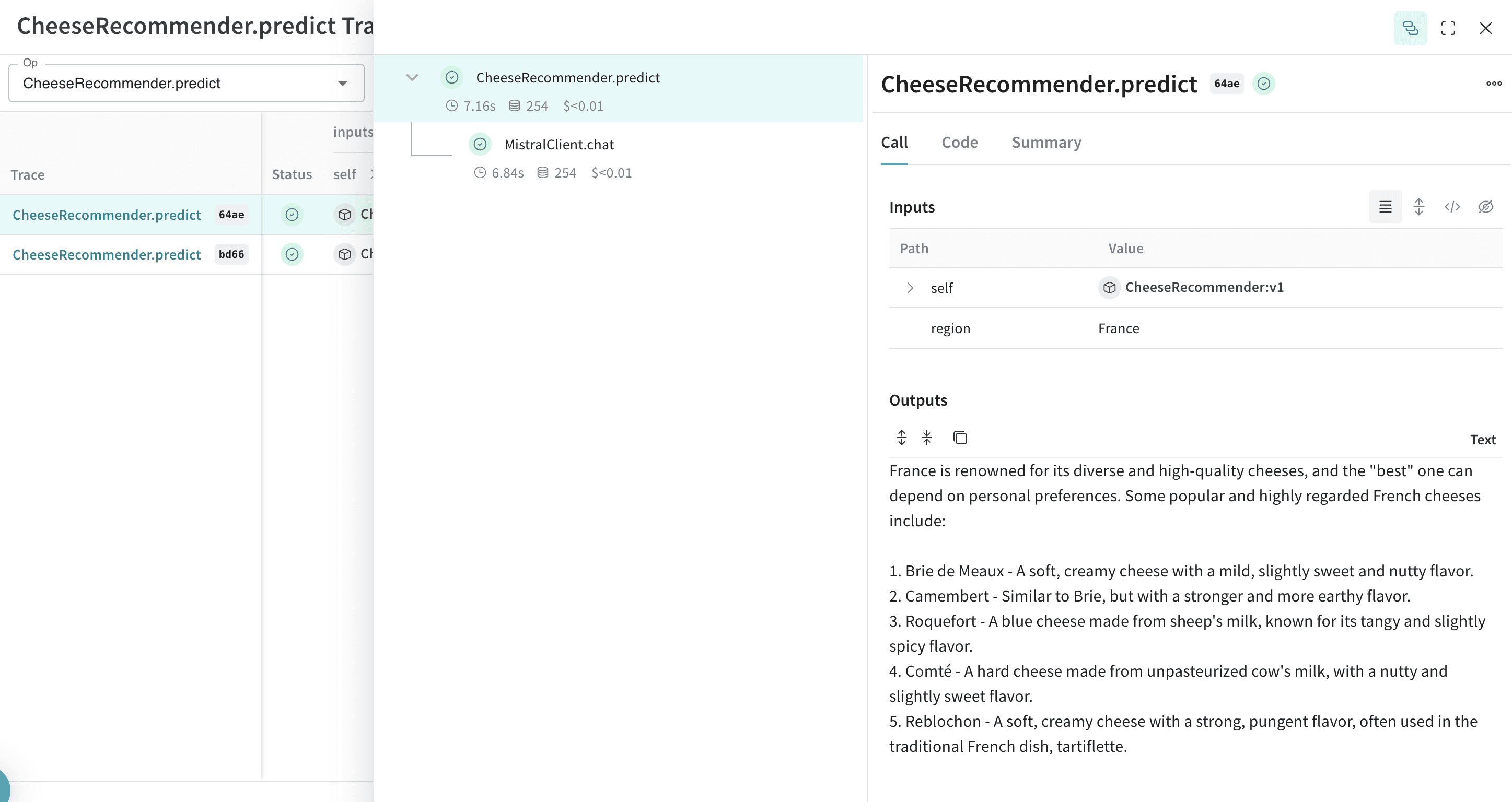 ](https://forge.coreweave.com/wandb/capecape/mistralai_project/weave/models)
## Related topics
- [サンプルコードとノートブック](/ja/products/wandb/examples.md)
](https://forge.coreweave.com/wandb/capecape/mistralai_project/weave/models)
## Related topics
- [サンプルコードとノートブック](/ja/products/wandb/examples.md)